1. Hard, harder, hardest
Americans Hugh M. Rockwell and Stanley P. Rockwell developed a special technique to determine the hardness of steel. This is called the Rockwell scale, measured in HRC (Hardness Rockwell C). A specially designed device uses a ball or a diamond cone to apply pressure to the material to measure its hardness.
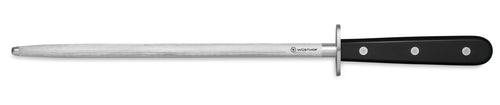
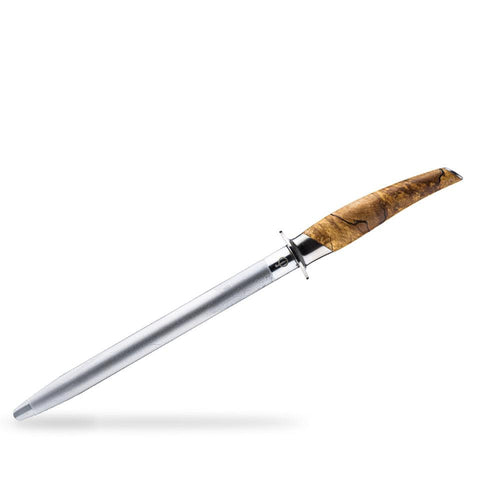
Below 52 HRC, the steel is so soft that the quality of the knife is very poor. These are often poorly produced knives from China. We advise against buying these knives. Knives with a hardness of 53 HRC to 58 HRC are of high quality, but wear out faster and therefore need to be well maintained. You can easily do this yourself with, for example, a honing steel or a sharpening stone. The scale goes up to 62 HRC. These knives are complex to make because they are forged in a specific way. This is truly the crème de la crème among knives.

The hardness of the steel also indicates how long a knife stays sharp. For example, a 52 HRC knife stays sharp for about a week, while a 62 HRC knife only needs to be sharpened once a year. The sharpness of your knife also depends on the sharpening angle, but more on that later. The disadvantage of a knife with high hardness is that it is more susceptible to damage and rust formation. By using and maintaining them correctly, this can be prevented.
Is your knife suitable for the true Braadbaas life?
Another fun fact: the hardness of the steel also depends on the country of origin. For example, the hardest knives are made in Japan, and German knives are often softer. View all Braadbaas Japanese knives here.
2. Small but mighty
The angle at which a knife is ground says a lot about its sharpness. The smaller the sharpening angle, the more precisely you can cut with the knife. Asian knives truly excel in this. Due to the hard steel, the sharpening angle can be ground smaller than Western knives. Asian knives have a sharpening angle of up to 15 degrees per side, while Western knives have 20 degrees per side. It is advisable to regularly sharpen knives with a smaller sharpening angle to keep them razor-sharp!
3. How flexible is your blade?
The toughness of the knife determines how much the blade can deform before it breaks. By adding different raw materials, such as silicone or chromium, to the steel, variations in toughness can be achieved. Toughness is in line with the hardness of the steel. Soft steel is very tough, which means a knife does not break easily. The disadvantage is that the knife quickly becomes dull. Hard steel is not tough, making the knife more vulnerable to breakage. An advantage of this is that the knife stays sharp for a long time.

4. Put your knives to the test
Is your knife worthy of a 'Braadbaas'? Test the sharpness of your knife with these everyday tricks.
First, the paper test. Hold a piece of paper and place the knife a small distance from your hand. Then make a cutting motion from the tip of the knife to the heel. Does the knife glide through the paper effortlessly? Then your knife is sharp enough. Does the paper tear or does the knife hesitate during the test? Time to sharpen your knife!
For the true daredevils, there's the nail test. Hold your thumb slightly angled downwards. Place the knife straight on your thumbnail without applying pressure. If your knife doesn't slide off but stays perfectly in place, your knife is very sharp. Would you rather not lose your thumb? Then use a plastic pen instead of your nail.
With the tomato test, you can easily test your knife in practice. With a sharp knife, you can effortlessly cut a slice of tomato. Don't apply pressure and make a slicing motion. Your knife is sharp enough if the tomato doesn't get squashed and no liquid comes out.
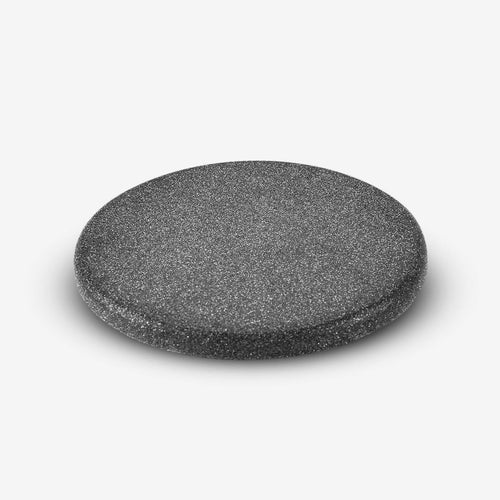
Do your knives need a refresh? At Braadbaas, we offer, among other things, the Horl knife sharpener, a honing steel, or a sharpening stone. You can use these to sharpen your knives at home. Or bring them to a professional knife sharpener. Are you satisfied with the quality of your knives? Then it's important to maintain them well. Here's how to do it! It's also important to use your knives for the right purposes, you can find this in this blog.