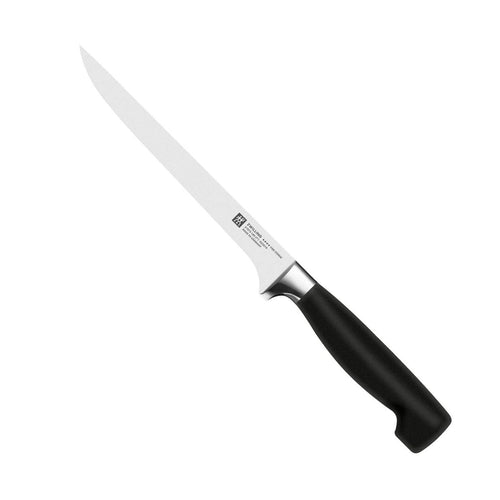
The anatomy of a knife
A knife consists of many different parts with various names. Let's take a look at how it's put together.

- The blade, the most important part of the knife, is made of different types of iron. A blade is forged in multiple layers. By mixing materials such as nickel and chromium with iron, variation can be introduced in the hardness of the knife. This also prevents rust formation.
- The spine is the top of the blade.
- The edge makes it possible to cut.
- Above the edge is the grind, the width of this grind depends on the size of the knife. The grind makes the edge less vulnerable and makes cutting easier.
- At the end of the edge is the heel, which is often not sharpened. Nowadays, knives without a heel are also becoming more common.
- The bolster protects you while cutting, as it prevents your hands from coming into contact with the edge.
- The handle should fit comfortably in the hand. Other important features of the handle are good grip and stability.
- The blade has an extension called the tang. The handle, pommel, and bolster are attached to the tang.
- The pommel is the rear part of the handle and ensures the knife is balanced.
Indispensable knives
As a beginner chef, it can be difficult to determine which knives you need for a good basic set. The knives below can be used for many different purposes.
Chef's knives
A chef's knife is indispensable in your kitchen. It is used for cutting fish, meat, and vegetables, among other things. Because the blade has a rocking shape, you can cut with a rocking motion. Chef's knives are available in different lengths; your choice depends on what you want to cut with it. In addition to the rocking motion, the chef's knife is also suitable for chopping, making it a true all-rounder. View our collection of chef's knives here.

Bread knives
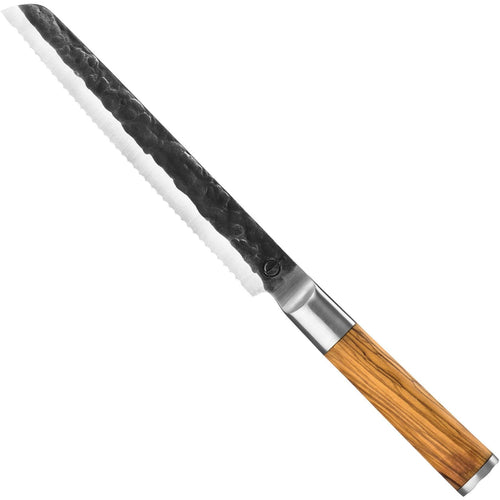
Your baguette would love nothing more than to be sawed in half by the long blade of your bread knife. The serrations ensure that the knife easily cuts through foods with a hard exterior and soft interior. The blade of a bread knife is thick, so it can withstand pressure well and does not break. A bread knife is not only suitable for bread, but also for cake, lettuce, quiche, tomato, and sausage. View our collection of bread knives here.
With a good knife, you can conjure up the most beautiful dishes!Paring knives
The paring knife is the little brother of the chef's knife; it's used for precision work. For example, the paring knife is ideal for cutting and chopping smaller vegetables, fruits, and herbs. The small blade of the paring knife creates a smaller cutting surface, but it is easier to handle and fine to use for foods that are close at hand when processing. So grab a longer chef's knife if you need a larger cutting surface. View our collection of paring knives here.

Carving knives
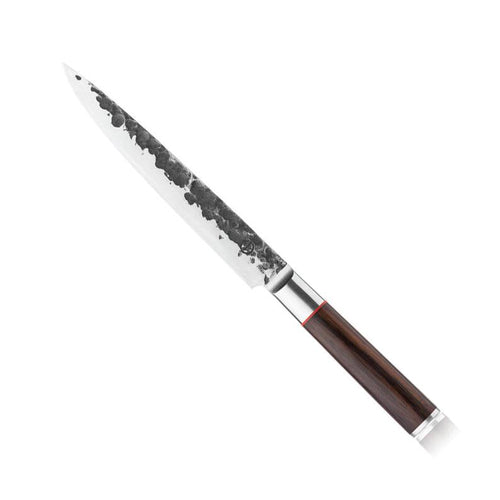
A carving knife has a narrow blade, which prevents you from damaging the fibers of the meat, resulting in a nicer outcome. You can use the carving knife to process raw meat more precisely. A carving knife is not suitable for cutting through bones and joints, as the knife is not sturdy enough for this. Are you looking for a knife to cut through bones? Then a cleaver is the right choice. View our collection of carving knives here.

Paring knives
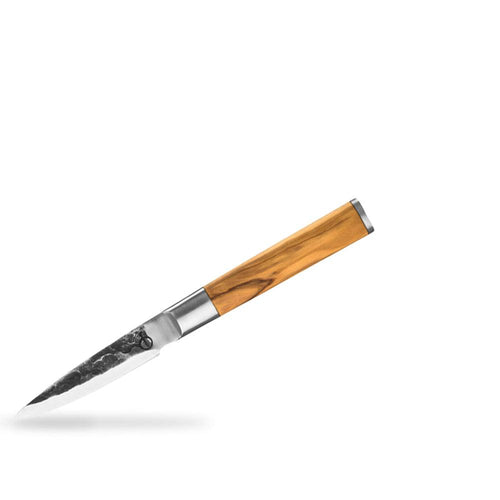
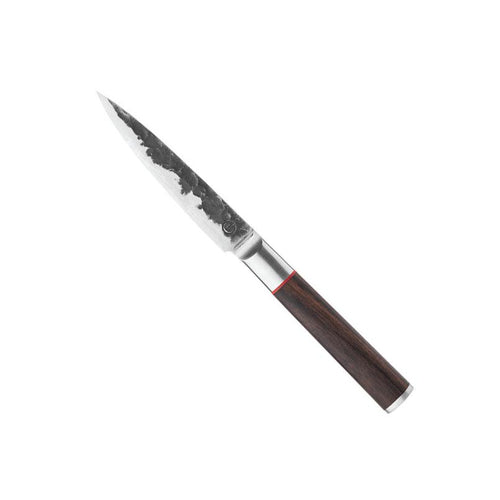
The name already reveals what this knife is for; peeling and cleaning potatoes and onions, for example. The knife has a short blade with often a straight edge. Paring knives are also available with a curve, perfect for turning potatoes, zucchinis, cucumbers, carrots, and root vegetables. View our collection of paring knives here.
Elevate your culinary skills
Are you already more experienced in the kitchen? Then it might be a good idea to expand your knife set for even more cooking pleasure. The knives below have specific purposes, helping you to process food even better.
Butcher knives
The long butcher knives are designed for portioning large cuts of meat. The curve in the blade allows you to easily cut along bones. Other features include the thickness of the knife, which makes it less fragile. Butcher knives can be used for cooked and uncooked meat and are great for slicing beautiful pieces. View our collection of butcher knives here.

Cleavers
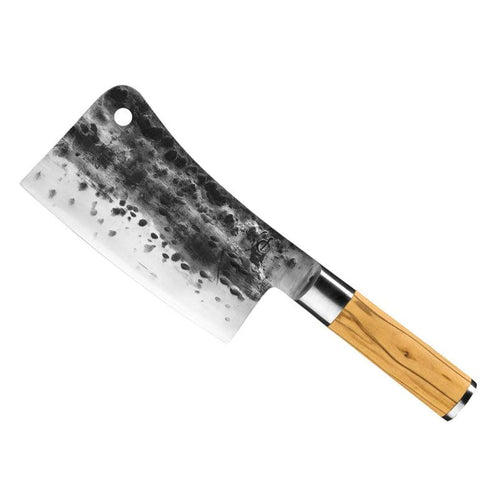
This knife, with its distinctive rectangular blade, is designed for heavier work. A cleaver is made of a softer steel, which makes the knife more resistant to shocks. With a cleaver, you can easily chop bones, joints, and harder vegetables. But the cleaver can also help you with finer work, such as julienning. Julienning is slicing vegetables and herbs into thin slices or strips at high speed. View our collection of cleavers here.

Santoku knives
This knife is the Japanese chef's knife. Santoku means 'three virtues', as it can cut, chop, and slice fish, meat, and vegetables.
The straight cutting edge of the santoku knife allows you to cut forwards, backwards, and downwards. The santoku knife is also available with dimples in the blade. This creates air between the knife and the food, which prevents food from sticking to the blade. Another difference between the santoku knife and a European chef's knife is that a santoku knife is more compact and has a thinner blade, allowing for more precise cutting. View our collection of santoku knives here.

Utility knives
The utility knife is very general in use, suitable for everything. It can help you cut vegetables, fruits, and herbs, as well as clean meat. Utility knives are available in different sizes. Choose a longer blade if you need a larger cutting surface. A narrower utility knife is easier for making rotating movements and for more precise work. View our collection of utility knives here.
Sashimi knives
The sashimi knife, also known as the yanagiba, is named after the dish for which the knife is most commonly used; sashimi. Sashimi is a Japanese dish of fresh, raw fish and shellfish cut into thin slices.
A characteristic of this knife is its long blade. Additionally, the knife is sharpened on one side, allowing for very precise cutting. This is very important in Japanese cuisine. The sashimi knife is also suitable for meat. Are you looking for a knife to make sushi? Then this knife can help you cut at a perfect ninety-degree angle. View our collection of sashimi knives here.

Filleting, boning, and carving
If you are already a true boss in your own kitchen, you can challenge yourself with these three techniques. To work more efficiently, these techniques have their own knives. This makes it easier to process meat, fish, and poultry.
Filleting
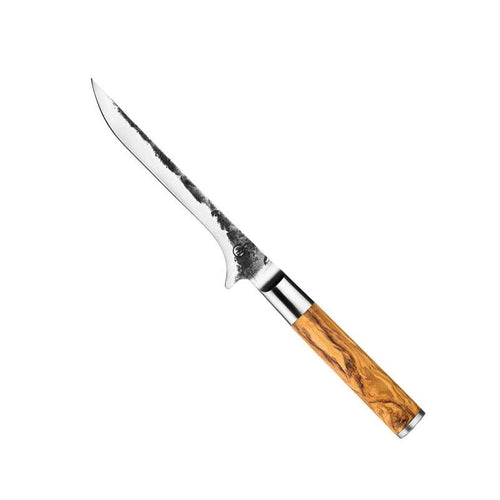
You can learn to fillet! Filleting is removing bones from fish, but also deboning meat and poultry falls under this. This knife has a narrow blade with a sharp tip, which allows you to efficiently cut along the bone. Fillet knives are available in different variants. Are you looking for a knife that wastes as little fish or meat as possible? Then the flexible fillet knife is perfect for you. The stiff fillet knife is made for coarser work; you could even use it for boning. If you plan to do this often, it is a better idea to invest in a good boning knife. View our collection of .

Boning
Boning is the removal of bone from meat and poultry. This technique also includes splitting meat, such as ham on the bone and shoulder ham. The boning knife has a stiffer blade than a fillet knife, but is still flexible enough to easily cut along bones and tendons. The handle is on the large side, so it can be gripped firmly. This knife can also help you remove tendons and fat. View our collection of boning knives.

Carving
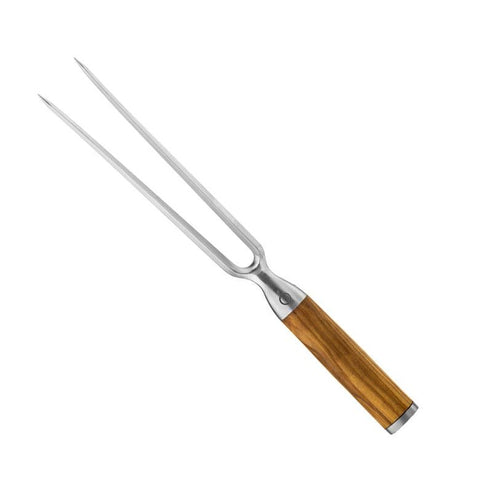
Carving is slicing already cooked meat. Such a slice of meat is called a tranche. By slicing the meat diagonally, the slices appear larger. Combine the carving knife with a matching carving fork. You can use this to secure the meat, which makes cutting easier and also looks cool. View our carving knives.

It doesn't matter if you've just started cooking or if you're already an experienced grill master... One thing is for sure: a good knife makes cooking much more fun and easier! Are you curious about how to best maintain your new knives? Then check out this blog!