Take matters into your own hands 🔪
It's important to regularly sharpen your knives. Sharp knives cut more smoothly and safely. Additionally, a reasonably sharp knife is easier to touch up than a dull knife is to restore. With a dull knife, you have to grind away more material. This shortens the lifespan of your knife and sharpening itself takes more effort and time. So don't wait until your knife is so dull that you can only use it for spreading.
How often you should sharpen your knives depends on how intensely you use the knife and the steel it's made from. But how do you know when it's time for a sharpening? You'll often notice it yourself during use. There are also several ways to test the sharpness of your knife. In this blog, you'll read three different common household tricks.

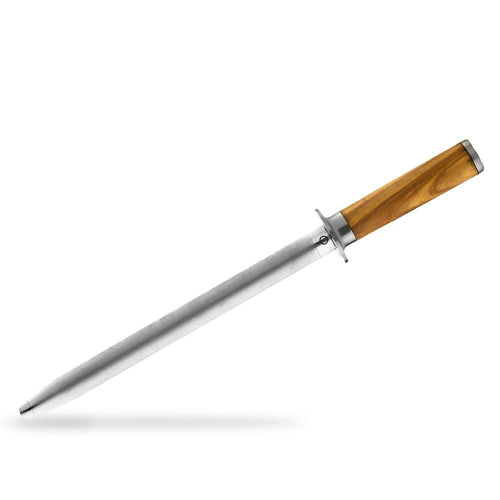
Honing with a honing steel
It's not always immediately necessary to sharpen your knives. For interim maintenance, use a honing steel. During cutting, small bends occur in the steel. This is also called burr formation. With a honing steel, you straighten such a burr again.
The easiest way to use a honing steel is to place it perfectly straight, tip down, on a flat surface. Then, move the knife along the honing steel with a smooth and light motion. Do this simultaneously from top to bottom and from heel to tip. After about 6 to 8 times per side, your knife will be razor-sharp again. Muscle power and speed are not important; however, you must hold the knife at the correct angle. For European knives, this is 20 degrees, and for Japanese knives, you use a 15-degree angle.
The knife cuts both ways.It is important that your honing steel is made of harder steel than your knife. For European knives, a standard honing steel suffices. For a Japanese knife, you need a diamond honing steel (also known as a sharpening rod). With this, you not only straighten the burr but also remove a layer of steel. View our collection of honing steels here.

Time for a good sharpening session
There comes a point when your knife can no longer be sharpened with a honing steel. Then it's time for the real work: sharpening your knives. This restores a knife to its original shape. By removing a small layer of metal, a new edge is created. We have listed the different tools you can use for this:
Water sharpener
This is a commonly used method to sharpen your knives. For this reason, a water sharpener can be found in many kitchen drawers. The sharpening angle is fixed. This makes it not suitable for all types of knives, but very practical to use. You pull your knife from heel to tip through the slot. After about 10 times per slot, your knife is ready for cutting.

Sharpening Rod
With a sharpening rod, you use the same technique as with a honing steel. The difference between a honing steel and a sharpening rod is that a sharpening rod removes significantly more material from the knife. A diamond sharpening rod works quickly and effectively. The diamond dust layer is strong enough for any steel, but it sharpens coarsely. A ceramic sharpening rod, on the other hand, sharpens much finer. This results in a nicer and sharper result. However, you need to be more careful with it. If you drop a ceramic sharpening rod, it's likely to break.
With a sharpening rod, you can sharpen not only your regular kitchen knives but also serrated knives like a bread knife. With a sharpening rod, you sharpen one side of the knife, serration by serration. Then, you go over the other side once to remove the burr on the back. It is important that the diameter of your sharpening rod matches the serration of the knife.
HORL
With the HORL knife sharpener, sharpening knives is a piece of cake. Instead of running your knife over a sharpening stone, you roll the sharpening stone along your knife. No water is needed, and the magnet ensures that your knife stays at the correct sharpening angle. Curious how exactly to do this? You can read about it in our blog about sharpening knives with HORL.

For years of cutting pleasure, maintaining your knives is important. Choose the tool that suits you best and get started with sharpening your knives yourself! Curious about what else you can do for optimal care? You can read about that in this blog. 😎